
My grandma used to shout for me in this weird way that I tried for years to correct until I gave up. “Ustiiiinahhh!”, she’d call. The iiii which should sound like the i in alien, sounded more like the e in elephant elongated to almost infinity to my ears. I hated that distortion of my name, but she was my grandma, so I learned to ignore it. On the outside. I always flinched a little on the inside when she changed me like that. The little difference overlaid itself onto the regular me and for a while pretended to be real. We fought a savage little battle, this invented girl and I, before I could vanquish her and come back to normal.
Sometimes when she called me like this from the other room, or from the street below where I always wanted to be, hoping I might trick some kid into playing with me, she needed to send me to the shops for the thirteenth time that day. I was always down for another walk in the neighbourhood. As I’m writing I don’t even retain the memory of what so much energy felt like. Other times she just wanted to tell me something because she’d been by herself for too long that day.
That particular time she sent me out for flour. She was set on baking cozonac, a sweet bread with various possible fillings, raisins, walnuts, poppy seeds or Turkish delight. She knew I liked the walnut and poppy seed ones and had a mind to make me some even if it was after Easter. “You haven’t tasted mine this year,” she said. A truth, but not the whole truth. What she really craved was to show I eat better at her place.
This incomprehensible competition with my mother confused me. Why all the effort to prove she was better? She already was. She made me pancakes whenever I wanted, her tea was the only one I could drink without wanting to vomit from the herbal smell, she told me she loved me, she hugged me often and gave me shoulder massages when my schoolbag knotted my puny muscles. And her cozonac was spectacular, soft, silky, almost half of it filling, not remotely resembling the crumbly, mealy, barely-smeared-with-walnut-cream variety my mother made.
Later I’d figure out she wasn’t trying to convince me, but to show off through me. From where I stood, had it been possible, I would’ve moved with her permanently, to live the life of a child granddaughter in the quiet symbiosis of me providing connection to the outside and she keeping me alive with sweets and telling me silly stories I never believed. I was too little still to fathom the power of growing up, of the world altering me and her and the radical rifts that’d bring. Then, she and I were eternal in that duality of care and indulgence I’d never find again.
“Find poppy seeds, and the big crystal sugar, and helas, and sifon,” she said when ready to go, I extended my hand for the money.
“I thought you just needed flour,” I moaned a little because the list required multiple long trips in opposing directions, poppy seeds and helas forced me to go all the way to the open market, but for the special sugar I had to walk to the other side of the neighbourhood.
Helas, a favourite of mine, came in a little, gaudy, plastic, yellow bottle full of the sourest liquid, a replacement for lemons, which I hadn’t had the privilege to see until that point. The tinge of sweetness, an aftertaste of sugar it left on my tongue made me brave the tartness and squirt some directly in my mouth when no one was watching.
Sifon, water infused with carbon dioxide by a mystifying contraption connected to massive, bomb-like containers, could be procured from a retired old man who’d opened a smashingly successful little business in a garage at the bottom of a block of flats. Waiting in line to get two bottles usually took more than half an hour, the caterpillar of people extending down the street, the size of the whole school opposite the shop.
All of this meant the arrival of cozonac got pushed back at least an hour and I was already drooling for it. Of course, I’d get it that night or maybe even the next morning as the preparation was lengthy and effortful. Only the kneading and the main proofing of the dough could take the better part of 4 hours and there were other steps in between. I refused to consider the baking time and the cooling, you never ever, under any circumstance cut cozonac before it was cold. This last commandment sounded like another of grandma’s superstitions, although my mother said it, too. That didn’t mean it wasn’t one, or some invented rule to keep me away from what I loved most in the world, cake.
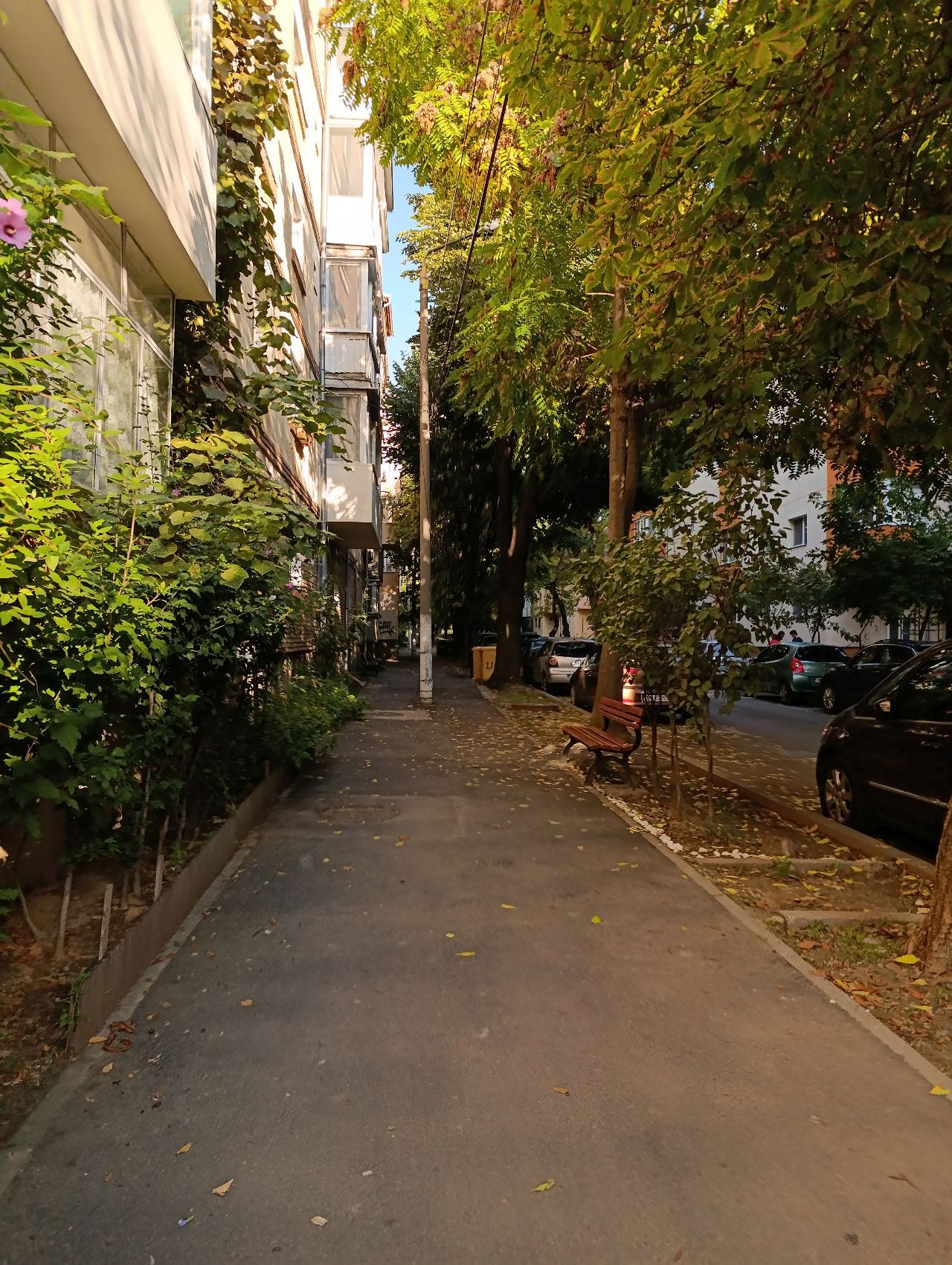
Outside, the neighbourhood, the city, embraced me as it always did with a sense of expansion, my vision adjusted just a smidge, the buildings and trees and the pavement became a tiny bit bigger and warmer and closer. That’s why I liked to be outside, the city cared for me, it said foreign words into my ears. Even though I didn’t understand them, the privilege of receiving such secret knowledge told me I had an ally.
In the open market the concrete floor stuck to my soles, the blood of countless vegetables and fruit spilled and only summarily washed, compelled me to step lighter. After I’d found what I came for, I turned onto a street I didn’t usually use. At twelve a completely ordinary street is an entire universe. Walking on an unfamiliar one is almost like stepping into a new dimension. You don’t know its particularities, or its dangers. When outside I listened to the city speak and where the soft wind of its voice was warmer I ventured forth. But sometimes I took chances.
In front of one of the blocks of flats lining the street a few older girls and boys, already teenagers, the girls with visible breasts under their shirts, and pants rounding their hips, the boys with hair full of gel, and new voices that convinced them they’d already turned into men were laughing around the outline of a hopscotch pattern.
The safe option when given the chance, is to avoid groups of kids you don’t know, but that day the thought of cozonac had emboldened me. I walked by them, looking ahead yet alert to any glimpse I could catch from the corner of my eyes. Unknown kids filled me with exhilaration and terror both. With them, like with dogs, eye contact is dangerous, it invites aggression. But I’d miscalculated how harmless they were and the weight of the bag handles on my shoulder eased all of a sudden.
“What have you got there, little girl?” a shrill girl asked and laughed. I moved to get the bag back and she threw it to one of the boys. I stopped, knowing the more I struggled the more fun they’d have. Pretending I didn’t care but staying firm and not saying anything had made other groups of kids get bored and leave me alone. Showing any kind of emotion was a no no, unless you had enough anger and enough power to actually hurt someone.
My body in its tininess invited kids my age and older to harass me. They all thought I had tears to shed, cries to cry, that I’d beg if they pushed enough. Instead I turned mute and stared them directly in the eye, a trick I’d learned early. When in danger already, you could look people dead in the eyes and surprise them with determination. Kids are great torturers in the right conditions, but their resolve is flimsy, quick satisfaction is what they’re after. This group though, were already drunk on some impulse I intuited but didn’t understand yet and kept at it, the more I stared them down the grimmer they got, the more intent. I didn’t have enough money to buy the things in my bag again if they took them, so I readied myself for a little physical pain. I had a quest, to get the bag safely home where cozonac was already being conceived in a big bowl with a little flour, yeast and sugar, covered with a striped tea towel grandma favoured for festive rituals.
Despite the familiar reactions, the fast as a hummingbird heartbeat, the vibration on my arms, the band of light around my forehead that covered the world in a hazy film, I’d been ready for the fight, as ready as you can be when you’re twelve and fragile, but ten minutes in fear and worry that I’d cave wormed itself into me. Maybe my knees would refuse to support me, or tears would come without my permission and then I’d surely lose the bag, the poppy seeds, the bottle of helas. They hadn’t looked inside yet, but I knew once they did, the yellow container would be lost. I wasn’t the only one partial to it, everyone squeezed it on their tongues with abandon and then shuddered in both discomfort and pleasure, as the tartness hit and pushed the body to shake, to contract, then the aftertaste would settle victorious at the base of the tongue and down the throat.
I didn’t relent, and neither did they, upset now that I couldn’t be bullied and one of them opened my canvas bag and took out the treasure I was so afraid to lose. Then the air changed a little, just before a muscular man appeared from behind a far corner opposite us. His upper body swelled under his t-shirt so much he looked deformed and he walked funny, but I couldn’t tell why because his legs hid behind a large white, oil-stained apron. My expression must’ve changed when I noticed his face because the kids all turned to look in the same direction. He wore an animal mask, a stag or a buck or a zimbru, or all together mingling maybe, changing maybe, I didn’t know, I didn’t understand. His whole body one moment huge, full, strong, transformed the next into that of a much older man, not only his muscles slacked, but the skin on his arms shrivelled and became spotted, then turned back at the next step. He came towards us that way, almost limping from the constant shift between ages.
He put his arm under his apron and took out a wooden stick, something obscene in the gesture transferred to the object, the weapon, it began to wriggle like a live animal, a snake, a fish. The kids around me screamed: “The Bloj, the Bloj,” and ran, some upstairs in the building, others down the street and disappeared around the corner. Then I was alone with this Bloj, my bag on the ground, the bottle of helas rolling slowly in the street.
He looked at me and now that the fear of the others had gone, I noticed his eyes under the mask, old with white lashes, pleats of loose skin, the shape and size of regular human eyes, yet completely inhuman, maybe a long time ago human. His body remained youthful at rest, so strong he resembled a wild animal more than a person. The image of old and young together seeped into my brain but remained nonsensical. The Bloj spoke to me with those eyes, the heat of the stare hit me and slid away, as if my body were oily and ungraspable, with no cracks in my childishness yet. I vaguely comprehended why the others had run. This man, this creature, could influence you in a way I knew of, distantly, but which remained foreign. I did the only thing I knew. I stared him down because the bottle was too close to him and I didn’t have enough courage to approach. He nodded, hid his stick back into his apron and left. I retrieved the bottle and ran. The buildings, the trees lowered a little to me and caressed my back with their presence all the way home. I didn’t look back even once.
Other fiction you might like:
Turkish delight is a Turkish dessert. It's like jello, but made of mostly sugar and starch to help it hold shape. It comes in a variety of colours and flavours. The simpler ones are green, red and yellow and are usually used as extra ingredients in other cakes and cookies. Do a google search and you'll see how it looks like. I'm glad the story resonated with you and that the pronounciation detail landed well. Thank you for your comment.
My first of your stories read. You drew me all the way in. Question, what is Turkish delight? Caterpillar of people! Made me stop and reflect on the mental image. Ustiiiinahhh! I heard it as Tony sang Maria’s name in West Side Story at 0.25 of this clip
https://youtu.be/DyofWTw0bqY?si=X8XBYdYYLhomHvGk
Made me think of how the endless possible differences of pitch in calling someone’s name can convey endless possible differences of intended meanings. Thank you!